
 Japanese


Custom Brake Solutions
Brake solutions tailored to your equipment requirements.
We develop brake specifications tailored to your equipment, including hollow-shaft designs, multi-disc structures, low-profile configurations, and custom voltage and wiring requirements.
DESIGN CHALLENGE
Do you have brake requirements that standard products cannot meet?
We develop custom brake specifications based on your application, mounting requirements, and operating conditions.
We need a design that allows wiring to pass through the center of the brake.
We can design a hollow-shaft structure.
We need to achieve the required torque despite restrictions on outer diameter or thickness.
We can use a multi-disc structure for outer-diameter constraints and a low-profile design for thickness constraints.
We need to accommodate power supplies such as 12 V, 24 V, or 36 V without changing brake size or torque.
We can design the coil specification to match your supply voltage.
We need to change the lead-wire outlet position or wiring method to suit the equipment.
We can adapt the design by changing the wire outlet position, adding clearance grooves, or changing terminals and connectors to suit the equipment.
We need the mounting method and hub shape to match the motor, equipment, and shaft configuration.
We can design mounting dimensions and hub geometry to match your equipment specifications
We need to reduce wear and improve durability based on operating conditions and cycle frequency.
We can develop specifications focused on wear reduction and extended service life.
CUSTOM PATTERNS
Custom Design Options
We tailor brake structures, dimensions, wiring, and electrical specifications to your equipment requirements.
Hollow-Shaft Brake

We design a hollow-shaft structure to allow shafts, wiring, or piping to pass through the center of the brake, based on your equipment requirements.
Customization Options
- Accommodation of hollow and rotating shafts
- Space for wiring and piping
Multi-Disc Brake

By using multiple friction surfaces, this design can achieve higher torque without increasing the brake’s outer diameter. We tailor the design to the required torque and available installation space.
Customization Options
- Designs for equipment with outer-diameter constraints
- Required torque within a limited outer diameter
Low-Profile Brake

This design reduces brake thickness to fit within limited axial space. We develop the structure based on the required torque and mounting conditions.
Customization Options
- Reduced brake thickness
- Designs for limited axial space
Voltage Modification

We design the coil specification to match the equipment’s power supply, including 12 VDC, 24 VDC, and 36 VDC.
Customization Options
- Support for various DC supply voltages
- Coil design matched to equipment power specifications
Wiring Modification

We can modify lead-wire outlet positions, terminals, connectors, clearance grooves, and other features to suit the equipment’s wiring and assembly conditions.
Customization Options
- Changes to lead-wire outlet position and clearance grooves
- Support for specified terminals and connectors
Mounting and Hub Modification

We modify the brake mounting and hub geometry to match the motor, equipment, and shaft configuration. Mounting dimensions, hub bore, and shaft connection methods can all be adapted for proper integration into the equipment.
Customization Options
- Mounting dimensions matched to the motor or equipment
- Hub geometry matched to shaft diameter and shape
Wear Reduction and Extended Service Life

We review the operating conditions and develop specifications aimed at reducing wear and extending brake service life.
Customization Options
- Designs for high-frequency operation
- Specifications aimed at reducing wear and replacement frequency
Weight Reduction

We evaluate weight-reduction options while maintaining the required structural strength and magnetic performance.
Customization Options
- Weight reduction to meet equipment weight requirements
- Lightweight specifications that maintain required strength and magnetic performance
SOLUTION CASES
Solution Cases
Explore how we adapt brake designs to solve specific equipment challenges.
CASE 01
Low-Profile, Hollow-Shaft Design

Challenge
Need to route a shaft, wiring, or piping through the center
For equipment requiring open space through the center, we review the center-bore dimensions, mounting conditions, and required holding torque to develop an appropriate specification.
CASE 02
Weight Reduction Through Yoke Redesign
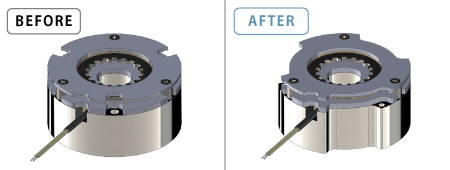
Challenge
Need to reduce brake weight
We review the yoke geometry with consideration for magnetic flux flow to reduce weight while maintaining the required braking performance.
CASE 03
Design Adaptation for Wiring Requirements
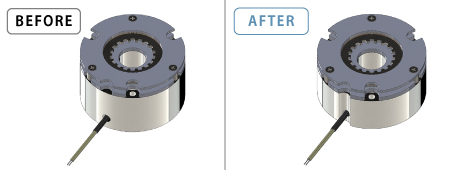
Challenge
Difficulty routing lead wires and motor cables
We review the wiring route, potential interference with moving parts, and connector position to determine the appropriate lead-wire length and outlet direction.
PROJECT FLOW
Custom Brake Development Process
From initial consultation to mass production, we support each stage of custom brake development.
1
Consultation
Review of application and requirements
2
Requirement Review
Organize and confirm required specifications
3
Design Proposal
Proposal of an optimized specification and structure
4
Prototyping & Evaluation
Prototype production, evaluation, and verification
5
Mass Production
Finalization of production specifications and stable supply
CONTACT CHECKLIST
Please Share Whatever Information Is Available
Your specifications do not need to be fully defined before contacting us.
If drawings or specification documents are available, we can review your requirements in greater detail.
Product / Equipment Requirements
- Application / equipment name
- Required holding torque
- Outer-diameter / thickness constraints
- Shaft diameter / mounting dimensions
- Required lead-wire length
- Wire outlet position / direction
- Supply voltage
- Operating frequency
- Operating-noise requirements
- Estimated annual quantity
Current Challenges
- Where standard products do not meet requirements
- Product to be replaced
- Service-life / wear concerns
- Heat generation / power-consumption concerns
- Need for a hollow-shaft design
- Need for a low-profile design
- Insufficient torque
- Wiring / connector-position constraints
- Availability of drawings / specifications
FAQ
Frequently Asked Questions
A spring-applied brake uses spring force to brake or hold the load when power is off or the coil is de-energized, and releases when the coil is energized. Holding force is therefore maintained during a power failure or emergency stop.
Yes. We can evaluate custom specifications for outer diameter, thickness, mounting, hub geometry, voltage, service life, operating noise, and other requirements. Please contact us with whatever information is currently available.
Products using an overexcitation specification require a dedicated voltage controller. Please contact us for detailed specifications and connection requirements.
Yes. We can help organize the requirements based on the information available, such as the application, installation space, required torque, and voltage conditions.
Brake Inquiries & Quotations
Contact us for assistance with anything from standard product selection to custom brake specifications.
TEL.+81-265-35-8288
Brake Inquiry Desk
Business hours: 9:00–17:00
(excluding Saturdays, Sundays, and public holidays)
Online Inquiries
Please contact us with any available drawings, specification requirements, or information about standard products you are considering.
Go to Contact Form